
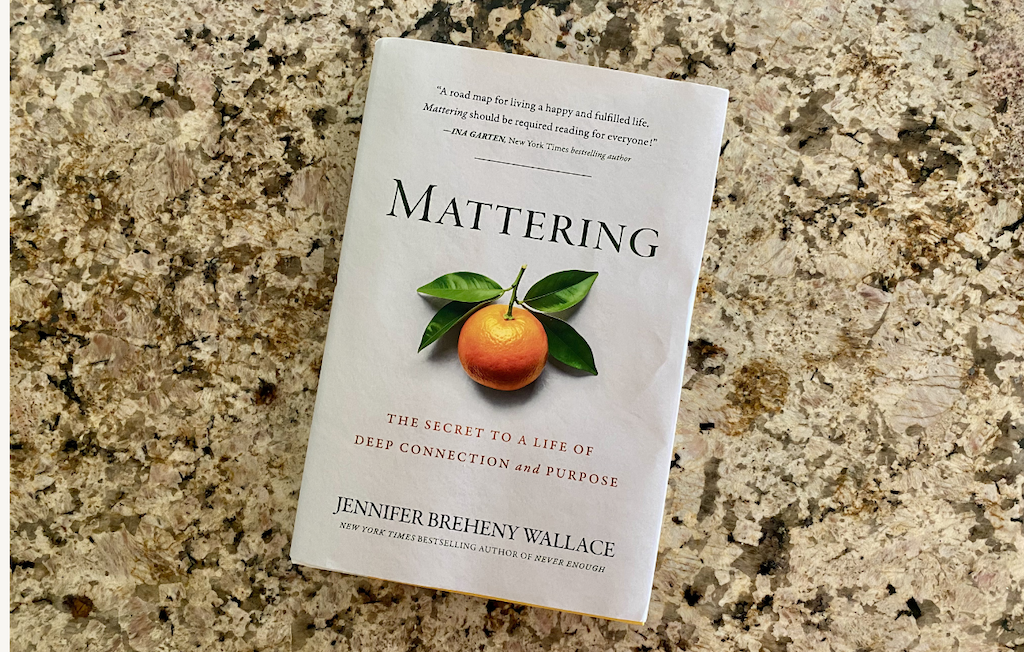
Here is a question most people never actually stop to ask themselves… Do I feel like I matter? Not in a dramatic, existential way. Just honestly. Quietly. To yourself. I have been sitting with this question a lot lately, partly because of a book I cannot put down… Mattering by Jennifer Breheny Wallace. And partly because, as a personal development coach who walked through the strange identity shift of an empty nest, I know firsthand how easily the answer to that question can drift toward “not really.”
If something about that lands for you, keep reading. Because this is for you.
What “Mattering” Actually Means (It’s More Specific Than You Think)
The word “mattering” gets tossed around loosely. But Wallace’s research, and the psychology behind it, breaks it down into something much more precise. Mattering is not just feeling good about yourself. It is the felt sense that you are significant to others… that you exist in a way that registers with the people and world around you.
According to the framework Wallace explores, mattering has a few distinct dimensions. Let’s look at them honestly.
Do Your Actions Feel Valued?
This is about recognition. Not applause… just acknowledgment. When you do something… whether it is showing up consistently at work, being the friend who always checks in, or quietly holding your life together… does anyone notice? Does it feel like it counts?
For a lot of women in their 20s and 30s, the answer is a hesitant shrug. You are working hard, building something, figuring it all out. But the validation loop is thin. Social media gives you likes, not meaning. A boss gives you a task, not necessarily appreciation. And somewhere underneath the busy-ness, there is a whisper asking… does any of this actually matter?
Would Your Absence Be Felt?
This one can sting. Imagine stepping away from your job, your friend group, your family dynamic, your community… would there be a noticeable gap? Would people reach for you?
This is not about being irreplaceable in a transactional sense. It is about being genuinely missed as you. As a specific person with a specific presence. Many women, especially in the years where they are still figuring out who they are becoming, struggle to believe their absence would create any kind of ripple at all.
Do You Feel Needed Because Others Depend on You?
Being needed feels good… until it becomes the only reason you feel like you matter. There is a difference between feeling mattering because people genuinely value your presence versus feeling mattering only when you are useful to someone. If the second one sounds more familiar, that is worth paying attention to.
Women in their 20s and 30s are particularly vulnerable to “mattering by function”… you matter because you are productive, helpful, capable, available. But what about when you are none of those things? What about when you are uncertain, tired, or still figuring it out? Do you still matter then?
Do You Feel Significant Because You Are Prioritized?
When was the last time someone rearranged something for you? Made a plan around your needs? Checked in without you having to ask first?
Feeling significant means believing you are a priority to people who matter to you. Not demanding center stage… just knowing you are genuinely considered. For many women navigating their 20s and 30s, this one is quietly painful. You are the one who adapts. The one who makes it work. The one who would never want to be “too much.” And in that generous self-erasure, you can start to feel invisible without ever meaning to.
Do You Feel Cared For Because Others Are Invested in Your Well-Being?
Not just your output. Not just your success. You. Your inner world. Your stress. Your dreams. Your struggles.
Wallace’s research points to something important here… mattering is not just about grand gestures of care. It is about the small, consistent signals that say “I see you, and I care what happens to you.” If those signals are rare in your life right now, that absence accumulates. It does not make you broken. It makes you human.
Do You Feel Deeply Understood and Meaningfully Responded To?
This is the most intimate layer of mattering. Not just heard… understood. Not just responded to… responded to in a way that shows someone actually got it.
Think about the conversations where you have tried to explain what you are going through and watched someone give you a surface-level response. The “you’ll be fine” or the pivot back to their own story. Now think about the rare moments when someone truly reflected your experience back to you. That felt completely different, didn’t it?
That difference is mattering. And if those moments are scarce in your life, you may have been quietly carrying more than you realize.
Why This Hits Differently in Your 20s and 30s
Wallace writes that mattering affects people across all ages and life situations, and she is absolutely right. But there is something particular about early adulthood that makes the mattering gap especially sharp.
You are in the middle of becoming. You have left some versions of yourself behind… the student, the daughter who lived at home, maybe the girl who had a clear plan. And you have not yet fully arrived at the next version. That in-between space is real, and it is disorienting.
At the same time, the cultural pressure on women in their 20s and 30s is relentless. You are expected to be building a career, maintaining a social life, possibly navigating relationships or singlehood with equal grace, tending to your mental health, growing as a person, and doing it all while looking like you have it together. It is exhausting. And in the middle of all that performing, the question of whether you actually matter… not what you accomplish, but who you are… can get completely lost.
Social media makes this worse, not better. The metrics of mattering online (likes, followers, engagement) are designed to feel meaningful while delivering almost none of the real thing. They create a mattering mirage… it looks like significance, but it does not feel like it.
Mattering Is Not Something You Either Have or Don’t
Here is what I want you to hear clearly: a low sense of mattering is not a personality flaw. It is not evidence that you are unlovable or that something is fundamentally wrong with you. It is often the result of environments, relationships, and life transitions that have not given you enough of the signals that build that sense over time.
That is not your fault. And it is also not permanent.
Mattering can be rebuilt. It can be cultivated from the inside out, even while you are working on the outside circumstances too. That is the work I love to do, and it is exactly what the Just Become You program is built around.
We work on this stuff in my JUST BECOME YOU hybrid coaching program.
What Working on Mattering Actually Looks Like
It is not just positive affirmations. It is not a vision board weekend. Real work on mattering looks like this…
- Getting clear on your own sense of self so your internal foundation is not entirely dependent on external validation
- Understanding the patterns that have shaped how you give and receive care, recognition, and belonging
- Learning to communicate your needs in ways that invite real connection rather than creating distance
- Identifying the relationships and environments that genuinely nourish your sense of significance versus the ones that quietly deplete it
- Building habits and practices that reinforce your own sense of worth independent of what others reflect back
This is deep, personal work. And it is also practical. Because when you start to feel like you matter… to yourself first, and then to the right people around you… everything in your life starts to shift.
The Just Become You hybrid program is designed for exactly this kind of growth. It meets you where you are, whether you are in a season of figuring things out, rebuilding after a hard stretch, or simply wanting more depth and intention in how you show up in your own life.
WHAT IS HYBRID COACHING AND IS IT ACTUALLY BETTER THAN WORKING ONE-ON-ONE WITH A COACH?
A Note From My Own Experience
I came to this work through my own version of the mattering question. After my kids left home, I found myself in an identity landscape that felt strangely quiet. The role that had structured so much of my sense of purpose and significance was shifting. And I had to ask myself, honestly… outside of that role, do I feel like I matter?
That question cracked something open. It led me here, to coaching, to the Just Become You program, and to conversations with women who are asking their own version of the same thing. Not because they are falling apart. But because they are awake enough to want more.
If you are asking this question… you are already doing something courageous.
Frequently Asked Questions
What does it mean to “matter” according to Jennifer Breheny Wallace?
In Mattering, Wallace draws on psychology research to define mattering as the felt sense that you are significant to others… that your presence is valued, your absence would be noticed, and that people are genuinely invested in your well-being. It is not the same as self-esteem, though the two are connected.
Is feeling like you don’t matter the same as depression or anxiety?
Not necessarily. A low sense of mattering can coexist with depression or anxiety, and it can also amplify them. But it is its own distinct experience. Many people who feel they don’t quite matter are high-functioning and outwardly successful… they are just quietly carrying an emptiness that has not been named yet.
How is the Just Become You program different from traditional therapy?
The Just Become You program is a personal development coaching experience, not therapy. It is forward-focused, action-oriented, and designed to help you build clarity, confidence, and connection in your daily life.
Can you work on mattering on your own, or do you need support?
You can absolutely do self-reflective work on mattering independently… journaling, reading, honest conversations with trusted people can all help. But many women find that working with a coach accelerates the process because it provides a consistent, outside perspective and accountability structure that is hard to replicate alone.
Who is the Just Become You program designed for?
The program is especially well-suited for women in their 20s and 30s who are navigating identity, purpose, and connection… whether that means figuring out a career path, healing after a difficult season, or simply wanting to feel more like themselves. FIND OUT MORE HERE.






0 Comments